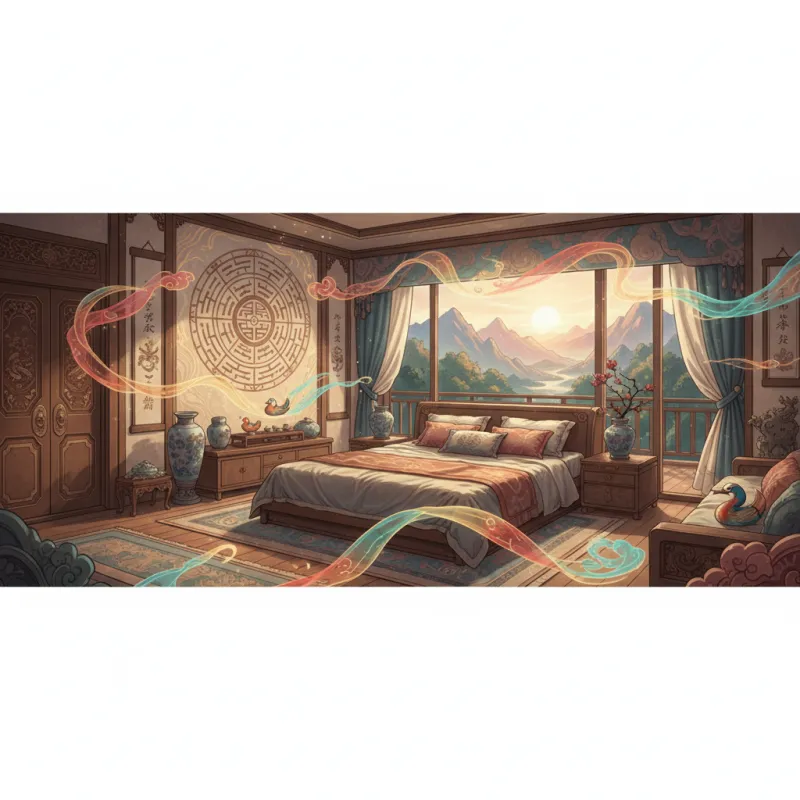
Your bedroom door opens to reveal a bed positioned directly in line with the entrance—what Feng Shui masters call the "coffin position." You might not feel it consciously, but your nervous system registers the vulnerability every night, keeping you in a subtle state of alert that fragments your sleep and drains your vitality. This is precisely the kind of energetic misalignment that Chinese metaphysical arts were designed to detect and correct, long before modern sleep science confirmed what ancient practitioners knew intuitively.
The Energetic Architecture of Sleep Spaces
Feng Shui (風水, fēng shuǐ) emerged during the Han Dynasty as a sophisticated system for reading landscape qi (氣, qì)—the vital energy that animates all living systems. The bedroom represents what classical texts call the "inner sanctum" of domestic space, where we spend roughly one-third of our lives in our most vulnerable state. The Huangdi Zhaijing (Yellow Emperor's Classic of House Siting), compiled during the Tang Dynasty, dedicates entire chapters to sleeping chamber arrangements, recognizing that nocturnal energy patterns differ fundamentally from daytime flows.
The bed itself functions as the energetic anchor of the room. Position it in the "commanding position"—diagonal from the door with a solid wall behind the headboard, allowing clear sight lines to the entrance without direct alignment. This configuration satisfies what the I Ching (易經, Yì Jīng) calls the principle of "knowing what comes" while maintaining "support from the mountain." I've observed that clients who resist this placement often report restless sleep and relationship friction, while those who embrace it describe feeling more grounded within weeks.
Consider the five elements (五行, wǔ xíng) in your bedroom's material composition. Wood promotes growth and vitality but can create excessive yang energy if overrepresented through too many plants or vertical lines. Metal brings clarity and precision but may feel cold in intimate spaces. Earth elements—ceramics, square shapes, earth tones—provide stability that most bedrooms desperately need. The Zhouyi (Zhou Dynasty I Ching) associates the bedroom with Kun (坤), the receptive earth hexagram, suggesting that grounding energy should predominate over stimulating forces.
Reading Your Bedroom Through I Ching Hexagrams
The I Ching offers a diagnostic framework for understanding bedroom dynamics beyond surface-level aesthetics. Each area of your sleeping space corresponds to specific hexagrams that reveal energetic patterns. The relationship corner (typically the far right from the entrance) connects to Hexagram 31, Xian (咸, Xiǎn)—"Influence" or "Mutual Attraction." When this area contains clutter, broken objects, or solitary imagery, it literally blocks the hexagram's natural expression of partnership energy.
I once consulted for a couple experiencing communication breakdowns. Their relationship corner housed a filing cabinet stuffed with old tax documents and a dying plant. The symbolism was almost comically literal—their partnership zone contained dead energy and bureaucratic obstacles. After clearing the space and introducing paired objects (two rose quartz stones, a photograph from their wedding), they reported their first productive conversation in months. The I Ching would interpret this as restoring the natural flow of Hexagram 31's lines, particularly the fourth line: "Perseverance brings good fortune."
The health area (center-left from the door) relates to Hexagram 27, Yi (頤, Yí)—"Nourishment." This zone should remain relatively empty and clean, as the I Ching teaches that proper nourishment requires discernment about what we allow into our systems. Bedrooms cluttered with exercise equipment, work materials, or electronic devices in this sector often correlate with digestive issues or chronic fatigue. The metaphysical logic is straightforward: if your nourishment zone contains stress-inducing objects, you're symbolically feeding yourself anxiety.
Bazi Considerations for Personalized Bedroom Harmony
While general Feng Shui principles apply universally, Bazi (八字, bā zì)—the Four Pillars of Destiny—reveals how bedroom arrangements should adapt to individual constitutional needs. Your birth chart's elemental balance determines which bedroom elements support or drain your personal qi. Someone with excessive fire in their Bazi (multiple Bing or Ding stems, or strong presence in the summer months) requires cooling, water-element influences in their bedroom: blues, blacks, flowing shapes, perhaps a small fountain. Conversely, a person with dominant water energy needs warming fire elements to prevent stagnation.
The day master (日主, rì zhǔ) in your Bazi chart indicates your core elemental nature. A Jia wood day master thrives with eastern-facing windows and morning light, aligning with wood's natural growth direction. A Geng metal day master benefits from western exposure and white or metallic décor that reinforces their constitutional strength. This isn't superstition—it's a sophisticated system for matching environmental inputs to individual energetic requirements, similar to how modern chronobiology recognizes that people have different optimal sleep schedules based on genetic factors.
Pay attention to your favorable elements (喜用神, xǐ yòng shén) when selecting bedroom colors and materials. If your Bazi analysis reveals that earth is your beneficial element, incorporate more earth tones, square shapes, and ceramic objects. If wood supports your chart, choose wooden furniture, green accents, and vertical design elements. I've seen clients transform their sleep quality simply by repainting their bedroom in a color that harmonizes with their Bazi constitution—one woman with weak fire in her chart reported vivid dreams returning after years of dreamless sleep once she added warm terracotta walls.
The Bedroom's Relationship to Your Life Palace
In Chinese metaphysics, the bedroom corresponds to your Ming Gong (命宮, mìng gōng) or Life Palace—the sector of your destiny chart governing personal vitality and life direction. The Ziwei Doushu (Purple Star Astrology) system maps this connection explicitly, showing how bedroom conditions directly influence your capacity to manifest your life purpose. A chaotic bedroom creates static in your Life Palace, obscuring clarity about your path and draining the energy needed to pursue it.
The bed's orientation relative to your Kua number (卦數, guà shù) determines whether you're sleeping in a direction that supports or conflicts with your personal energy. East group people (Kua numbers 1, 3, 4, 9) should position their heads toward east, southeast, south, or north while sleeping. West group people (Kua numbers 2, 6, 7, 8) benefit from west, northwest, southwest, or northeast orientations. This isn't arbitrary—it's based on the Later Heaven Bagua arrangement and how different directional energies interact with your birth data.
I'm consistently amazed by how many people unknowingly sleep in their "total loss" direction (絕命, jué mìng), which depletes vitality and invites obstacles. A client suffering from chronic insomnia discovered she'd been sleeping with her head pointing toward her worst direction for three years. Within a week of reorienting her bed to her "heavenly doctor" direction (天醫, tiān yī), her sleep normalized. The mechanism isn't mystical—it's about aligning your body's electromagnetic field with beneficial directional energies during the vulnerable sleep state.
Symbolic Language and the Subconscious Mind
Chinese metaphysics recognizes that our subconscious mind reads environmental symbols constantly, even during sleep. The images, objects, and arrangements in your bedroom communicate messages that either support or undermine your intentions. Single people who display solitary imagery—one person in a landscape, a lone tree, individual objects—are literally programming their subconscious for continued singleness. The bedroom should reflect the reality you're creating, not the one you're leaving behind.
Remove all water features from the bedroom, despite their popularity in other Feng Shui applications. Water represents the emotional realm and constant change—qualities that destabilize the bedroom's need for grounded, consistent energy. The Yangzhai Sanshe (Three Essentials of Yang Dwellings) explicitly warns against bedroom water features, associating them with emotional turbulence and, in extreme cases, infidelity. I've consulted for multiple couples who removed bedroom fountains and reported immediate improvements in relationship stability.
Mirrors require careful consideration in bedroom Feng Shui. The classical prohibition against mirrors facing the bed isn't superstition—it's based on the understanding that mirrors activate and multiply energy, creating a restless environment when you need stillness. Additionally, waking to see your reflection can startle the spirit (神, shén) before it's fully returned to the body, a concept modern sleep science might interpret as disrupting the natural transition from sleep to wakefulness. If you must have mirrors, position them inside closet doors or ensure they don't reflect the bed.
Seasonal Adjustments and Temporal Feng Shui
Advanced practitioners recognize that bedroom Feng Shui isn't static—it should shift with seasonal energy patterns and annual flying stars (飛星, fēi xīng). The annual star chart changes each February, bringing different elemental energies to each sector of your home. If the illness star (二黑, èr hēi) flies into your bedroom sector, introduce metal elements to weaken its earth nature—a metal singing bowl, white bedding, or round metal décor. This temporal dimension of Feng Shui acknowledges that energy patterns are dynamic, not fixed.
During winter months, when yin energy dominates, bedrooms benefit from slightly warmer colors and additional lighting to balance the seasonal darkness. Summer's yang excess calls for cooling blues and greens, lighter fabrics, and minimal décor to prevent energetic overheating. This seasonal attunement appears in the Lüshi Chunqiu (Spring and Autumn Annals of Master Lü), which describes how wise people adjust their living spaces throughout the year to maintain harmony with natural cycles.
The monthly energy shifts matter too, particularly during ghost month (the seventh lunar month) when yin energy peaks. Traditional practice suggests keeping bedroom windows closed at night during this period and avoiding major bedroom renovations. While this might seem superstitious, it reflects a sophisticated understanding of how seasonal energy fluctuations affect our vulnerability during sleep. Modern research on seasonal affective disorder and circadian rhythm disruptions validates the core insight that temporal factors significantly impact our rest quality.
Integrating Practice: A Systematic Approach
Begin your bedroom transformation by clearing everything that doesn't actively support rest, intimacy, or personal renewal. The bedroom isn't a storage unit, home office, or gym—functional confusion creates energetic confusion. Remove exercise equipment, work materials, and storage boxes. Each object you eliminate creates space for beneficial qi to circulate, following the principle that emptiness (空, kōng) is the foundation of fullness.
Next, address the bed itself: solid headboard against a wall, commanding position relative to the door, appropriate orientation for your Kua number. Invest in high-quality bedding in colors that support your Bazi elements. The Chinese concept of "sleeping on your wealth" suggests that bed quality directly correlates with prosperity consciousness—cheap, worn bedding symbolically devalues your rest and, by extension, yourself.
Finally, introduce intentional symbolic elements: paired objects for relationship energy, living plants (but not too many) for vitality, meaningful artwork that reflects your aspirations. Every object should pass the test: Does this support my highest intentions for this space? If you can't answer affirmatively, remove it. The bedroom should be a curated environment that actively nurtures your wellbeing, not a passive collection of furniture and belongings.
For deeper exploration of how Feng Shui principles apply to other intimate spaces, see Bathroom Feng Shui for Health and Wealth. Those interested in how bedroom arrangements affect specific life areas might explore Career Success Through Home Office Feng Shui.
Your bedroom is where you're most receptive, most vulnerable, and most open to energetic influence. Make it count.
Related Reading
- Feng Shui Bedroom Guide: Sleep Better Tonight
- Feng Shui Bedroom Layout Mistakes
- Mirrors in the Bedroom: Feng Shui Rules and Reasons
- Feng Shui Bed Placement: The Rules That Actually Matter
- Bedroom Feng Shui for Better Sleep
- Unlocking the Ancient Arts: Feng Shui, I Ching, and the Mysteries of Chinese Metaphysics
- Burial Feng Shui Explained: Ancestral Graves and Family Fortune
- Bedroom Feng Shui: Creating Your Personal Sanctuary
Explore Chinese Culture
- Explore Daoist philosophy and practice
- Explore traditional Chinese customs
- Explore ancient Chinese cosmology