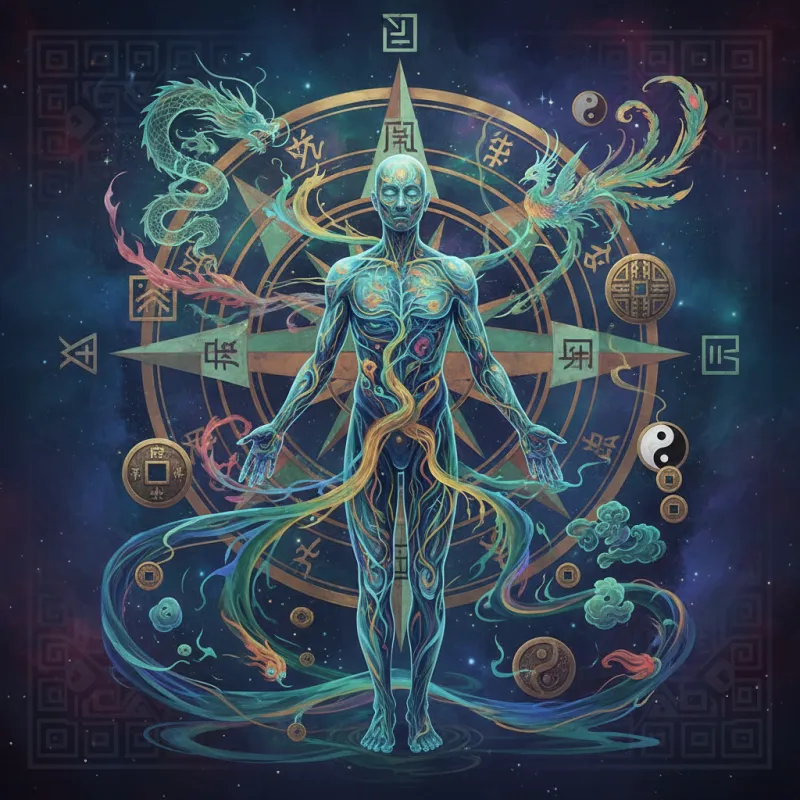
Your body contains twelve rivers that no doctor has ever seen. They don't appear on CT scans. They can't be dissected in an anatomy lab. Yet acupuncturists have been charting their courses for over two millennia, inserting needles at specific points along these invisible highways to redirect the flow of qi (气 qì) — and somehow, inexplicably, it works.
These are the meridians (经络 jīngluò), and they represent one of the most fascinating paradoxes in medicine: a system that shouldn't exist according to Western anatomy, yet produces measurable clinical results that even skeptical researchers struggle to explain away.
The Twelve Rivers and Their Organs
The meridian system consists of twelve primary channels, each named after the organ it governs. But here's where Chinese medicine diverges sharply from Western thinking: when we say "Liver meridian" (肝经 gānjīng), we're not just talking about the physical liver sitting in your abdomen. We're describing an entire functional system that includes the organ itself, its associated emotions (anger and frustration), its sensory connection (the eyes), its tissue affinity (tendons and ligaments), and its energetic pathway through the body.
The twelve primary meridians are: Lung, Large Intestine, Stomach, Spleen, Heart, Small Intestine, Bladder, Kidney, Pericardium, Triple Burner (三焦 sānjiāo — a uniquely Chinese concept with no Western anatomical equivalent), Gallbladder, and Liver. Each runs along a specific path, surfacing at precise acupuncture points before diving back into the body's interior.
The Lung meridian, for instance, begins deep in the middle burner (中焦 zhōngjiāo), descends to connect with the large intestine, then surfaces at the front of the shoulder and runs down the inner arm to end at the thumb. Eleven acupuncture points mark its external pathway. When this meridian is blocked or deficient, you might experience not just respiratory issues, but also skin problems (the lungs govern the skin in Chinese medicine), grief that won't resolve, or a tendency toward catching colds.
The Clock That Runs Your Body
Here's something your doctor probably never mentioned: your organs take turns being in charge. Every two hours, a different meridian reaches peak activity in what's called the Chinese Medicine Body Clock (子午流注 zǐwǔ liúzhù).
Between 3-5 AM, the Lung meridian is most active — which is why people with lung issues often wake during these hours, coughing or struggling to breathe. From 5-7 AM, the Large Intestine takes over, which is why this is the ideal time for bowel movements (your body is literally designed to eliminate waste at dawn). The Stomach meridian peaks from 7-9 AM, making this the optimal window for your largest meal of the day, despite what modern breakfast-skipping trends might suggest.
This continues around the clock: Heart (11 AM-1 PM), Small Intestine (1-3 PM), Bladder (3-5 PM), Kidney (5-7 PM), Pericardium (7-9 PM), Triple Burner (9-11 PM), Gallbladder (11 PM-1 AM), and Liver (1-3 AM). That 2 AM wake-up time when you're stewing in anger or anxiety? Your Liver meridian is trying to process emotions and detoxify your blood, and something's interfering with its work.
Traditional Chinese Medicine practitioners use this clock diagnostically. If you consistently experience symptoms at the same time each day, they'll look to the meridian active during that window. Afternoon headaches between 1-3 PM? Check the Small Intestine meridian and your digestive function. Waking between 3-5 AM with anxiety? The Lung meridian might be deficient, or you might be holding unprocessed grief.
Yin and Yang Pairs: The Meridian Partnership System
The twelve meridians don't operate independently — they're organized into six yin-yang pairs, with each pair sharing a common element from the Five Elements system. This pairing explains why seemingly unrelated symptoms often appear together.
The Lung (yin) and Large Intestine (yang) both belong to Metal element. This is why chronic constipation often accompanies respiratory weakness, and why skin conditions (governed by Lung) frequently improve when bowel function normalizes. The partnership runs deeper than Western medicine's simple anatomical connection between these organs.
Heart (yin) pairs with Small Intestine (yang) under Fire element. In Chinese medicine, the Heart houses the shen (神 shén) — your spirit, consciousness, and mental clarity. The Small Intestine, meanwhile, is called "the separator of pure from impure," and this applies not just to food but to thoughts and experiences. People with anxiety disorders often have both Heart and Small Intestine imbalances — they can't separate useful thoughts from mental garbage, and their spirit becomes disturbed.
The Spleen-Stomach pair (Earth element) governs digestion and the transformation of food into qi and blood. Kidney-Bladder (Water element) controls fluid metabolism, reproduction, and your fundamental life force. Liver-Gallbladder (Wood element) manages the smooth flow of qi throughout the body and your capacity for planning and decision-making. Pericardium-Triple Burner (Fire element) protects the Heart and regulates the body's three burning spaces.
Understanding these pairs is crucial because treating one meridian in a pair affects the other. Stimulating Large Intestine 4 (合谷 hégǔ), a point on the back of the hand, is one of the most powerful ways to clear Lung heat and stop headaches — because the Large Intestine meridian is the Lung's yang partner.
Where Meridians Meet the Physical World
The most common question about meridians is: "What are they, physically?" The honest answer is that we don't entirely know, and that ambiguity drives Western-trained doctors crazy. Meridians don't correspond to blood vessels, lymphatic channels, or nerve pathways, though they sometimes run parallel to these structures.
Some researchers have proposed that meridians follow fascial planes — the connective tissue networks that wrap every muscle, organ, and structure in your body. Fascia does conduct bioelectrical signals and mechanical tension throughout the body in ways that match meridian theory surprisingly well. When you stimulate an acupuncture point, you're often needling into a fascial intersection where multiple tissue planes meet.
Other studies have found that acupuncture points show measurably different electrical conductivity than surrounding skin — they're literally more conductive to electrical current. Some points also correspond to neurovascular bundles or motor points where nerves enter muscles. But none of these explanations fully accounts for the meridian system's complexity or its clinical effectiveness.
Perhaps the most intriguing research comes from Korean scientist Kim Bong-Han, who in the 1960s claimed to have discovered a previously unknown circulatory system of thin tubules that matched meridian pathways. His work was dismissed and forgotten during the Cold War, but recent studies using modern imaging techniques have begun to identify similar structures, now called the "primo vascular system." Whether this represents actual meridians or simply another layer of the body's communication network remains hotly debated.
The Eight Extraordinary Vessels: Reservoirs and Regulators
Beyond the twelve primary meridians lie eight extraordinary vessels (奇经八脉 qíjīng bāmài) that function as reservoirs and regulators of qi and blood. Unlike the primary meridians, these vessels don't connect directly to organs. Instead, they act like overflow channels and backup systems, storing excess qi when the primary meridians are full and releasing it when they're deficient.
The two most important extraordinary vessels are the Governing Vessel (督脉 dūmài) and the Conception Vessel (任脉 rènmài). The Governing Vessel runs up the spine and over the head, governing all yang energy in the body. The Conception Vessel runs up the front centerline, governing all yin energy. Together, they form the Microcosmic Orbit (小周天 xiǎo zhōutiān), a circuit that qigong practitioners learn to consciously circulate qi through.
The other six extraordinary vessels — Penetrating, Belt, Yin Heel, Yang Heel, Yin Linking, and Yang Linking — have more specialized functions. The Belt Vessel (带脉 dàimài), for instance, is the only meridian that runs horizontally around the waist like a belt, and it's responsible for binding all the vertical meridians together. When the Belt Vessel is weak, you might experience a sense of things "falling apart" — both physically (prolapsed organs, hernias) and emotionally (inability to hold things together).
These extraordinary vessels are particularly important in treating chronic, deep-seated conditions and constitutional imbalances. They're also central to internal alchemy practices where practitioners work to refine and circulate qi for health and spiritual development.
Meridians in Practice: How Acupuncture Actually Works
When an acupuncturist inserts a needle at Stomach 36 (足三里 zúsānlǐ) on your lower leg to treat digestive issues, they're not just poking randomly and hoping for a placebo effect. They're accessing a specific point on the Stomach meridian where qi tends to gather and can be influenced.
Each of the 361 classical acupuncture points has specific functions based on its location, the meridian it belongs to, and its relationship to other points. Some points are like major highway intersections where multiple meridians meet. Others are specialized for moving qi, building blood, clearing heat, or resolving dampness.
The art of acupuncture lies in selecting the right combination of points to address not just symptoms but the underlying pattern of imbalance. A headache isn't just a headache in Chinese medicine — it might be Liver yang rising, Kidney deficiency failing to anchor yang, blood stasis, wind invasion, or phlegm obstruction. Each pattern requires different points on different meridians.
What's remarkable is that stimulating points far from the problem area often works better than local treatment. Liver 3 (太冲 tàichōng) on the top of the foot is one of the most powerful points for treating headaches, eye problems, and emotional stress — all because it strongly moves Liver qi and clears stagnation throughout the entire meridian pathway.
Modern research has confirmed that acupuncture produces measurable physiological effects: it releases endorphins and other neurotransmitters, reduces inflammation, improves blood flow, and modulates the autonomic nervous system. But these Western explanations, while valid, miss the elegance of the meridian theory that guided practitioners to discover these points thousands of years before we had the technology to measure neurotransmitters.
Living in Harmony with Your Energy Highways
Understanding meridians isn't just academic knowledge — it's a practical framework for daily health maintenance. The meridian system connects directly to feng shui principles in that both recognize qi as the fundamental life force that must flow smoothly for health and wellbeing.
Pay attention to your body's two-hour rhythms. If you consistently feel energized or depleted at certain times, you're receiving information about which meridians need support. Eat your largest meal when the Stomach meridian is strongest (7-9 AM), not when it's weakest (7-9 PM). Go to bed before 11 PM so your Gallbladder and Liver meridians can do their restorative work during their peak hours.
Learn the pathways of the meridians most relevant to your health concerns. If you have shoulder tension, trace the Small Intestine meridian from your little finger up your arm to your shoulder blade — you'll often find tender points along this path that respond well to massage or acupressure. If you have digestive issues, work with the Stomach and Spleen meridians on your legs.
The meridian system reminds us that the body is not a collection of separate parts but an integrated network where everything connects to everything else. That persistent cough might be telling you about unresolved grief. That afternoon energy crash might be revealing a Spleen deficiency that's been developing for years. Those 2 AM wake-ups might be your Liver's way of saying it's overwhelmed by stress and toxins.
Your body contains rivers that Western medicine has never mapped, flowing along pathways that ancient physicians charted with nothing but observation, palpation, and centuries of clinical experience. These invisible highways carry the qi that animates your flesh, and learning to work with them — rather than against them — might be the most practical health knowledge you ever acquire.
Related Reading
- Yin and Yang in Health: The Balance That Keeps You Well
- Five Elements in Body and Home
- Feng Shui and TCM Connection
- Qi Energy Explained: What It Is and Why It Matters
- Five Element Compatibility: The Productive and Destructive Cycles
- Black in Feng Shui: Power, Depth, and When to Use It
- Compass School Feng Shui: When Direction Becomes Destiny
Explore Chinese Culture
- Explore Daoist philosophy and practice
- Explore traditional Chinese customs
- Explore ancient Chinese cosmology