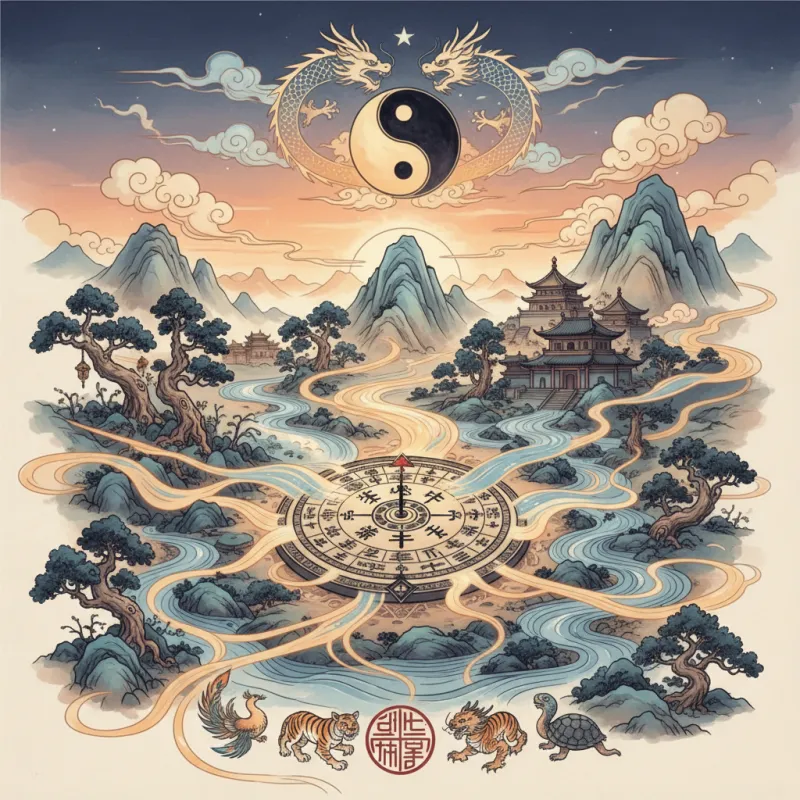
Ask a physicist about energy and they'll give you equations. Ask a Chinese doctor about qi (气 qì) and they'll check your pulse, look at your tongue, and tell you whether your qi is rising, sinking, stuck, or deficient. These aren't metaphors. In the Chinese medical worldview, qi is as real as blood, as measurable as temperature, and far more important than either.
The problem is that qi doesn't translate. We call it "energy" because we need something to write in English, but that word carries baggage from physics class — joules, calories, the first law of thermodynamics. Chinese qi follows different rules. It can be thick or thin, turbid or clear, ascending or descending. It responds to seasons, emotions, and the arrangement of furniture. It's simultaneously the most concrete and most abstract concept in Chinese thought, which is exactly why it matters.
What Qi Actually Means (And Why One Definition Won't Work)
The character 气 originally depicted steam rising from cooking rice. That image tells you everything: qi is both the substance (the rice, the water) and the transformation (the steam, the rising). It's matter becoming energy becoming matter again.
In classical Chinese texts, qi appears in dozens of contexts that seem unrelated until you realize they're all describing the same fundamental principle. The Huangdi Neijing (黄帝内经 Huángdì Nèijīng), the foundational text of Chinese medicine written around 100 BCE, describes qi as the substance that animates the body, circulates through meridians, and determines health or disease. The Zhuangzi (庄子 Zhuāngzǐ), written centuries earlier, uses qi to explain how the universe itself operates — the condensation and dispersion of qi creates and destroys all things.
The Neo-Confucian philosopher Zhu Xi (朱熹 Zhū Xī, 1130-1200 CE) spent considerable effort trying to clarify the relationship between qi and li (理 lǐ, principle or pattern). His conclusion: li is the blueprint, qi is the building material. You can't have one without the other. A house needs both architectural plans and bricks.
This is why translating qi as "energy" fails. Energy in physics is a property of matter, a measurement. Qi in Chinese thought is both the thing and its properties, both the actor and the action. It's the air you breathe, the act of breathing, and the vitality that breathing provides.
The Five Types of Qi Your Body Can't Live Without
Chinese medicine doesn't treat qi as one undifferentiated substance. It distinguishes at least five major types, each with specific functions and pathologies. Understanding these distinctions is like understanding the difference between arterial blood, venous blood, and lymph — they're all fluids in your body, but confusing them would be medically disastrous.
Yuan qi (元气 yuán qì), or original qi, is what you inherit from your parents. It's stored in the kidneys and determines your constitutional strength. Some people are born with robust yuan qi and can party until dawn, eat garbage, and still feel fine. Others have weak yuan qi and need to be careful about everything. You can't create more yuan qi, but you can preserve what you have — which is why Chinese medicine obsesses over not wasting it through overwork, excessive sex, or chronic stress.
Zong qi (宗气 zōng qì), or gathering qi, forms in the chest from the air you breathe and the food you eat. It powers your heart and lungs. When zong qi is weak, you get shortness of breath, a weak voice, and poor circulation. This is the qi that acupuncture most directly affects.
Ying qi (营气 yíng qì), or nutritive qi, circulates through the meridians with the blood, nourishing every tissue. It's the qi that makes your skin glow, your hair shine, and your muscles strong. Deficient ying qi shows up as pallor, fatigue, and poor healing.
Wei qi (卫气 wèi qì), or defensive qi, circulates on the body's surface and protects against external pathogens. It's your immune system, but also more than that — it regulates body temperature, controls sweating, and determines whether you catch every cold that goes around or sail through flu season untouched. Wei qi is strongest during the day and retreats inward at night, which is why you're more vulnerable to getting sick when you're sleep-deprived.
Zheng qi (正气 zhèng qì), or upright qi, is the umbrella term for all the qi that keeps you healthy. The Neijing states: "When upright qi is stored within, evil cannot invade." This is the fundamental principle of Chinese preventive medicine. You don't fight disease by killing pathogens (though that helps); you fight disease by making your body's qi so strong that pathogens can't get a foothold.
How Qi Moves (And What Happens When It Doesn't)
Qi has four basic movements: ascending, descending, entering, and exiting. These aren't metaphors. Your stomach qi should descend (that's how food moves down). Your lung qi should descend (that's how you exhale). Your spleen qi should ascend (that's how nutrients get distributed). Your liver qi should spread smoothly in all directions (that's how emotions flow).
When these movements go wrong, you get specific, predictable symptoms. Rebellious stomach qi (qi moving up instead of down) causes nausea, vomiting, and acid reflux. Sinking spleen qi causes prolapse, chronic diarrhea, and a feeling of heaviness. Stagnant liver qi — probably the most common pattern in modern life — causes irritability, depression, a feeling of tightness in the chest, and pain that moves around.
I once watched a Chinese medicine doctor diagnose liver qi stagnation in about thirty seconds. The patient walked in sighing heavily, sat down with slumped shoulders, and said she felt "stuck" in her life. The doctor didn't need to hear anything else. Sighing is the sound of liver qi trying to move. That stuck feeling isn't psychological — it's the literal sensation of qi not flowing smoothly. The treatment involved acupuncture points that "course the liver and rectify qi" (疏肝理气 shūgān lǐqì), and the patient reported feeling lighter within minutes.
This is what Western medicine misses by not having a concept equivalent to qi. We can measure neurotransmitters and hormones, but we can't measure the flow of something through the body that isn't a substance. Chinese medicine can, because it's been doing it for thousands of years.
Qi in Feng Shui: Why Your House Has a Pulse
The same principles that govern qi in the body govern qi in your environment. This is the foundation of feng shui, which literally means "wind and water" — the two forces that disperse and gather qi.
The Zangshu (葬书 Zàngshu, Book of Burial), written by Guo Pu (郭璞 Guō Pú) in the 4th century CE, states: "Qi rides the wind and scatters, but is retained when encountering water." This single sentence explains why feng shui practitioners care so much about how air and water move through a space. Fast-moving qi (like wind rushing through a long corridor) disperses beneficial qi. Stagnant qi (like air in a cluttered room) becomes sha qi (煞气 shà qì), or harmful qi.
Good feng shui creates what's called sheng qi (生气 shēng qì), or generating qi — the kind of environmental qi that makes you feel alert, creative, and alive. You've felt this. Some rooms make you want to sit down and work. Others make you want to leave immediately. That's not psychology; that's qi.
The shape of a room affects qi flow. Sharp corners create cutting qi. Curved pathways allow qi to meander and accumulate. Clutter blocks qi like cholesterol blocks arteries. This is why feng shui consultants will tell you to clear your clutter before doing anything else — not because clutter is "bad energy" in some vague sense, but because it literally prevents qi from moving.
Cultivating Qi: What the Daoists Figured Out
If qi is the fundamental substance of life, then cultivating it should be the fundamental practice of living. The Daoists took this seriously. They developed elaborate systems of meditation, breathing exercises, dietary practices, and internal alchemy aimed at refining and accumulating qi.
The basic principle is simple: you lose qi through activity, stress, and dispersion. You gain qi through rest, proper breathing, and concentration. The Daodejing (道德经 Dàodéjīng) advises: "Can you concentrate your qi and achieve softness like an infant?" Infants have abundant qi because they haven't learned to waste it through worry, tension, and striving.
Qigong (气功 qìgōng), literally "qi work," encompasses hundreds of practices, but they all involve the same core elements: regulating the body (through posture and movement), regulating the breath (through specific breathing patterns), and regulating the mind (through focused attention). The goal is to make qi flow smoothly, accumulate in the lower dantian (丹田 dāntián, an energy center below the navel), and eventually refine it into something more subtle.
The Daoist internal alchemists described a process of transforming jing (精 jīng, essence) into qi, qi into shen (神 shén, spirit), and shen into emptiness. This sounds mystical until you realize it's describing a real physiological process. Jing is your constitutional vitality, stored in the kidneys. Through specific practices, you can transform that stored potential into active qi, then refine that qi into mental clarity and spiritual awareness.
Does this actually work? I've met enough qigong practitioners with unusual vitality and presence to think there's something real happening. Whether it's "qi" in the classical sense or some combination of improved breathing, reduced stress, and enhanced body awareness doesn't particularly matter. The practices work.
Why Modern Medicine Needs Qi (Even If It Won't Admit It)
Western medicine excels at treating acute conditions. Broken bone? We'll set it. Bacterial infection? We'll kill it. Heart attack? We'll stent it. But chronic conditions — fatigue, pain, digestive issues, autoimmune diseases — often leave Western doctors shrugging. "Your tests are normal. Maybe it's stress."
Chinese medicine looks at these same patients and sees clear patterns of qi dysfunction. Deficient qi, stagnant qi, rebellious qi, sinking qi. Each pattern has specific treatments that have been refined over centuries. The treatments don't always work, but they work often enough that dismissing them as placebo seems willfully ignorant.
The National Institutes of Health now funds research on acupuncture, tai chi, and qigong. The studies show measurable effects on pain, inflammation, immune function, and stress hormones. Researchers try to explain these effects through mechanisms like endorphin release, nervous system regulation, and fascia stimulation. They're probably all correct. But they're also describing qi from a different angle.
The concept of qi offers something Western medicine lacks: a unified theory of health that connects physical symptoms, emotional states, and environmental factors. You can't separate your liver qi stagnation from your job stress, your poor diet, and your cluttered apartment. They're all part of the same pattern. Treating one without addressing the others is like bailing water from a boat without fixing the leak.
Living With Qi: Practical Implications
Understanding qi changes how you approach daily life. You start noticing what depletes your qi and what replenishes it. You realize that staying up late scrolling your phone isn't just "bad for sleep" — it's actively dispersing your qi when it should be consolidating. You notice that certain people leave you feeling drained while others leave you feeling energized. That's not metaphor; that's qi exchange.
You become more careful about your environment. You notice that your cluttered desk makes you feel scattered (stagnant qi). You notice that opening windows in the morning makes you feel more alert (fresh qi entering). You notice that certain rooms in your house feel better than others, and you start arranging your space to maximize time in the good-qi rooms.
You pay attention to your breath. Most people breathe shallowly, using only the upper chest. This creates deficient lung qi and, over time, deficient qi throughout the body. Deep abdominal breathing — the kind that makes your belly expand — draws qi down to the lower dantian where it can be stored and refined. Five minutes of proper breathing can shift your entire state.
You eat differently. Not according to calories or macros, but according to what builds qi. Warm, cooked foods build qi better than cold, raw foods. Easily digestible foods preserve qi because your spleen doesn't have to work as hard. Foods appropriate to the season harmonize your qi with environmental qi. This is why Chinese dietary therapy emphasizes congee, soups, and stews — they're qi-building foods.
Most importantly, you stop treating your body like a machine that should run indefinitely without maintenance. Machines don't have qi. Living things do. And qi needs to be cultivated, protected, and replenished. That's not self-indulgence; it's basic maintenance of the one thing that keeps you alive.
Related Reading
- The Meridian System: Energy Highways in Your Body
- Five Elements in Body and Home
- Yin and Yang in Health: The Balance That Keeps You Well
- Feng Shui and TCM Connection
- Harmonizing Your Kitchen: The Role of Feng Shui and I Ching in Culinary Spaces
- Reflecting Harmony: The Role of Mirrors in Feng Shui and I Ching Divination
- Feng Shui Meets Minimalism: Where Ancient Wisdom and Modern Design Agree — Fengshui Perspective
Explore Chinese Culture
- Explore Daoist philosophy and practice
- Explore traditional Chinese customs
- Explore ancient Chinese cosmology