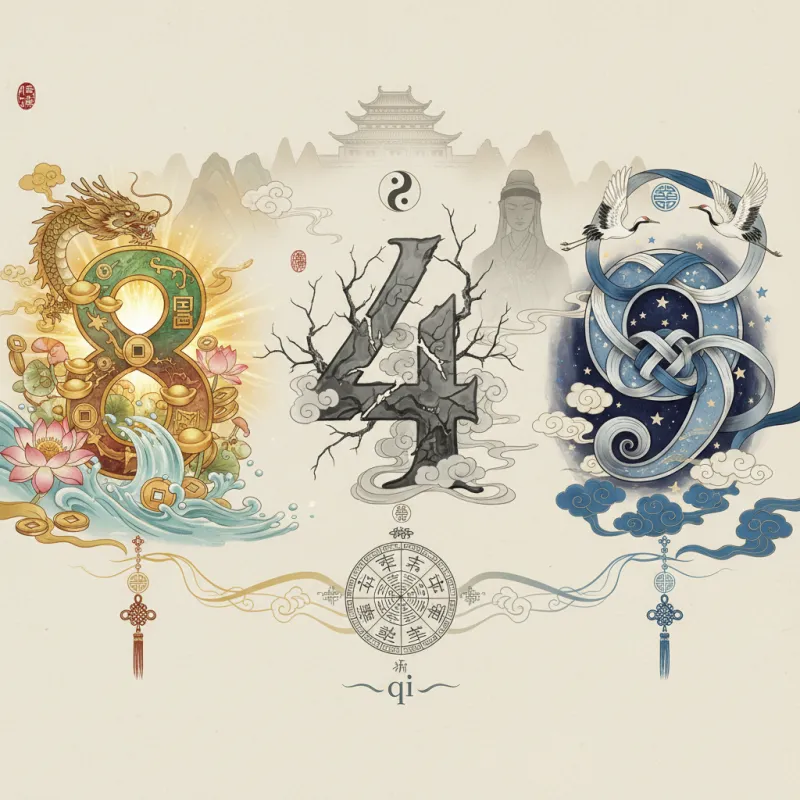
Walk into any luxury apartment building in Shanghai, and you'll notice something odd: the elevator buttons skip from floor 3 to floor 5, then jump from 13 to 15. Floor 4 doesn't exist. Neither does 14, 24, or any number with a 4 in it. Meanwhile, penthouses on the 8th, 18th, and 28th floors sell for 20-30% more than identical units on other levels. This isn't superstition—it's a linguistic accident that's shaped billions of dollars in real estate decisions, wedding dates, and even the timing of the 2008 Beijing Olympics.
The Homophone Trap: When Numbers Become Words
Chinese numerology operates on a principle that seems absurd until you understand the structure of Mandarin: the language has roughly 400 syllables, while English has over 8,000. This compression means that dozens of Chinese words share identical pronunciations, distinguished only by context and tone. Numbers, which are spoken constantly in daily life, inevitably collide with other vocabulary—and when a number sounds like "death" or "prosperity," the association sticks.
This isn't mysticism. It's pattern recognition hardwired into language itself. When you hear "four" (四, sì) and "death" (死, sǐ) pronounced almost identically hundreds of times, your brain creates a link. The tones differ slightly—fourth tone versus third tone—but in rapid speech, especially in dialects like Cantonese, they're nearly indistinguishable. The result is a number system where 4 feels unlucky not because of ancient divination, but because of pure linguistic coincidence.
Eight: The Number That Launched a Thousand Auctions
The number 8 (八, bā) sounds like 发 (fā), short for 发财 (fācái), meaning "to get rich" or "to prosper." This homophone has created an entire economy. In 2008, a Chinese businessman paid $215,000 for the phone number 8888-8888. License plates featuring multiple 8s routinely sell at government auctions for tens of thousands of dollars. When the Beijing Olympics organizing committee chose August 8, 2008, at 8:08:08 PM for the opening ceremony, they weren't being cute—they were making a statement about China's rising prosperity that every Chinese speaker would instantly understand.
The obsession with 8 intensifies when numbers combine. 88 is doubly auspicious. 888 suggests wealth flowing continuously. The number 168 (一六八, yī liù bā) is particularly prized because it sounds like "prosperity all the way" (一路发, yī lù fā). Real estate developers in Hong Kong, Singapore, and mainland China price units with 8s at significant premiums, and buyers pay willingly. This isn't irrational—in markets where resale value matters, a lucky number is a liquid asset.
Four: The Number Buildings Pretend Doesn't Exist
The number 4 (四, sì) sounds nearly identical to death (死, sǐ). Both use a falling tone, and in Cantonese—spoken in Hong Kong, Guangdong, and much of the overseas Chinese diaspora—the pronunciation is even closer. The result is tetraphobia, a fear of the number 4 that manifests in architecture, product design, and daily planning.
High-rise buildings across Asia skip floor 4 entirely, along with 14, 24, 34, and so on. Some buildings eliminate all floors containing the digit 4, meaning a 50-story building might only have 35 actual floors. Nokia, when entering the Chinese market, avoided releasing phone models with 4 in the model number. Gift-giving etiquette strictly prohibits giving four of anything—four books, four pieces of fruit, four dishes at dinner. At weddings, cash gifts (红包, hóngbāo) are carefully calculated to avoid amounts like 400 or 4,000 yuan.
The avoidance extends to dates. Hospitals report fewer elective surgeries scheduled on the 4th, 14th, and 24th of each month. Wedding planners steer couples away from April (the fourth month) and any date containing 4. This creates measurable economic effects: real estate studies consistently show that properties on floors containing 4 sell for 10-20% less than comparable units, and the discount increases with each additional 4 in the floor number.
Six and Nine: Smooth Sailing to Eternity
The number 6 (六, liù) sounds like 流 (liú), meaning "flow" or "smooth." It suggests things proceeding without obstacles, which makes it popular for business openings and important transactions. The phrase 六六大顺 (liù liù dà shùn)—"double six, great smoothness"—is a common blessing for new ventures. You'll see 66 or 666 used in store names, phone numbers, and promotional pricing, though the association is weaker than with 8.
Nine (九, jiǔ) is the emperor's number, but not for the reason most English sources claim. Yes, it sounds like 久 (jiǔ), meaning "long-lasting" or "eternal," which makes it popular for weddings and anniversaries. But 9's imperial status comes from the Yijing (易经, I Ching), where nine represents the ultimate yang number—maximum masculine, creative energy. The Forbidden City supposedly contains 9,999 rooms (it actually has about 980, but the symbolism matters more than the count). Dragons, the emperor's symbol, traditionally have nine forms. Nine sons of the dragon appear throughout Chinese art and architecture.
For modern purposes, 9 suggests longevity and endurance. The phrase 天长地久 (tiān cháng dì jiǔ)—"as eternal as heaven and earth"—uses 久 and appears in wedding vows and anniversary celebrations. Giving 99 or 999 roses has become a romantic gesture specifically because of this association. Unlike 8's commercial energy, 9 carries romantic and philosophical weight.
The Combinations: When Numbers Tell Stories
Chinese numerology gets interesting when numbers combine into phrases. The number 520 (五二零, wǔ èr líng) sounds like 我爱你 (wǒ ài nǐ)—"I love you"—and has become a digital-age Valentine's Day, celebrated on May 20th (5/20). Young couples transfer 520 yuan to each other via mobile payment apps as romantic gestures. The number 1314 sounds like 一生一世 (yī shēng yī shì)—"one life, one world" or "forever"—making it another romantic favorite.
Some combinations are ominous. The number 250 (二百五, èr bǎi wǔ) is an insult meaning "fool" or "idiot," derived from old currency denominations. Calling someone 250 is fighting words. The number 38 (三八, sān bā) sounds like a term for a gossipy, annoying woman—it's gendered and derogatory. These aren't based on homophones but on slang that evolved over decades.
Business combinations matter too. The number 518 suggests "I will prosper" (我要发, wǒ yào fā). The number 168, as mentioned, means "prosperity all the way." Real estate developments, restaurants, and shops carefully select addresses and phone numbers that tell auspicious stories when read aloud. This isn't decoration—it's marketing that speaks directly to cultural intuition.
The Five Elements Connection: When Numbers Meet Philosophy
While homophones drive popular numerology, classical Chinese thought connects numbers to the Five Elements (五行, wǔxíng): Wood, Fire, Earth, Metal, and Water. In Bazi (八字) fortune-telling, numbers 1 and 2 correspond to Wood, 3 and 4 to Fire, 5 and 6 to Earth, 7 and 8 to Metal, and 9 and 10 to Water. This system, derived from the Luoshu (洛书) magic square and the Hetu (河图) diagram, assigns elemental qualities to numbers based on their position in cosmological patterns.
A person whose Bazi chart shows weak Water element might be advised to incorporate 9 into their life—a phone number, address, or even the number of fish in an aquarium. Someone with excess Fire might avoid 3 and 4. This approach is more sophisticated than simple homophone luck, requiring calculation of birth date and time to determine elemental balance. It's the difference between folk numerology and technical metaphysics.
The two systems—homophone luck and elemental correspondence—sometimes conflict. The number 4, unlucky by pronunciation, corresponds to Fire in the elemental system and might be beneficial for someone with weak Fire. Practitioners of serious Chinese metaphysics navigate these contradictions by prioritizing context: elemental analysis for personal fortune-telling, homophone associations for public-facing decisions like business names and wedding dates.
The Modern Mutation: Digital Age Numerology
Internet culture has spawned new number meanings that have nothing to do with traditional homophones. The number 666 (六六六, liù liù liù), traditionally auspicious for its "smooth" connotation, now means "awesome" or "impressive" in gaming and social media, borrowed from the phrase 溜溜溜 (liū liū liū)—"slick, skilled." It's the Chinese equivalent of "pro gamer move."
The number 233 comes from an emoticon code on early Chinese forums, representing uncontrollable laughter. It has no homophone basis—it's pure internet archaeology. Similarly, 2333 or 23333 intensifies the laughter. These digital-native numbers coexist with traditional lucky numbers, creating a layered system where 888 means wealth to your grandmother and "hahaha" to your nephew, depending on context.
QQ numbers (China's dominant messaging platform before WeChat) with auspicious digits sold for thousands of dollars in the 2000s. Early WeChat users scrambled for IDs containing 8s and 6s. Even Bitcoin wallet addresses with lucky number patterns command premiums in Chinese crypto communities. The medium changes, but the impulse to find meaning in numbers persists.
Why It Matters: The Economics of Linguistic Coincidence
Chinese numerology isn't quaint folklore—it's a market force. Real estate developers factor number preferences into pricing models. Airlines avoid flight numbers with 4 and compete for routes with 8. Product launches, IPOs, and major announcements are scheduled around auspicious dates. When Alibaba chose November 11 (11/11) for Singles' Day, creating the world's largest shopping event, they turned a date made of 1s—suggesting individuality—into a commercial juggernaut.
The Hong Kong government auctions vehicle license plates, and numbers with 8s routinely sell for millions of HKD. In 2016, the plate "W 28" sold for HKD $2.5 million. The plate "R 8" went for HKD $1.9 million. These aren't vanity purchases by eccentric collectors—they're investments in social signaling and resale value.
Understanding Chinese numerology means recognizing that language shapes perception in ways that feel arbitrary from outside but are deeply logical within the system. When a number sounds like death every time you say it, avoiding that number isn't superstition—it's linguistic hygiene. When a number sounds like prosperity, paying extra for it isn't irrational—it's buying into a shared cultural narrative that affects real-world value.
The next time you see a building skip floor 4 or a price ending in 888, you're not witnessing ancient mysticism. You're seeing the practical consequences of a language with too few syllables and too many meanings, where numbers accidentally became words, and words became fate.
Related Reading
- Exploring the Interconnections of Feng Shui, I Ching, and Chinese Metaphysics
- Wedding Date Selection in Chinese Feng Shui
- Address Numerology in Feng Shui
- Chinese Numerology: The Lucky, the Deadly, and the Powerful
- Phone Number Feng Shui: Why Chinese People Pay Thousands for the Right Digits
- Harmonizing Your Kitchen: The Role of Feng Shui and I Ching in Culinary Spaces
- Chinese Meditation: A Guide to Daoist and Buddhist Practices
- The Bagua Map Explained: Your Feng Shui Floor Plan Guide
Explore Chinese Culture
- Explore Daoist philosophy and practice
- Explore traditional Chinese customs
- Explore ancient Chinese cosmology