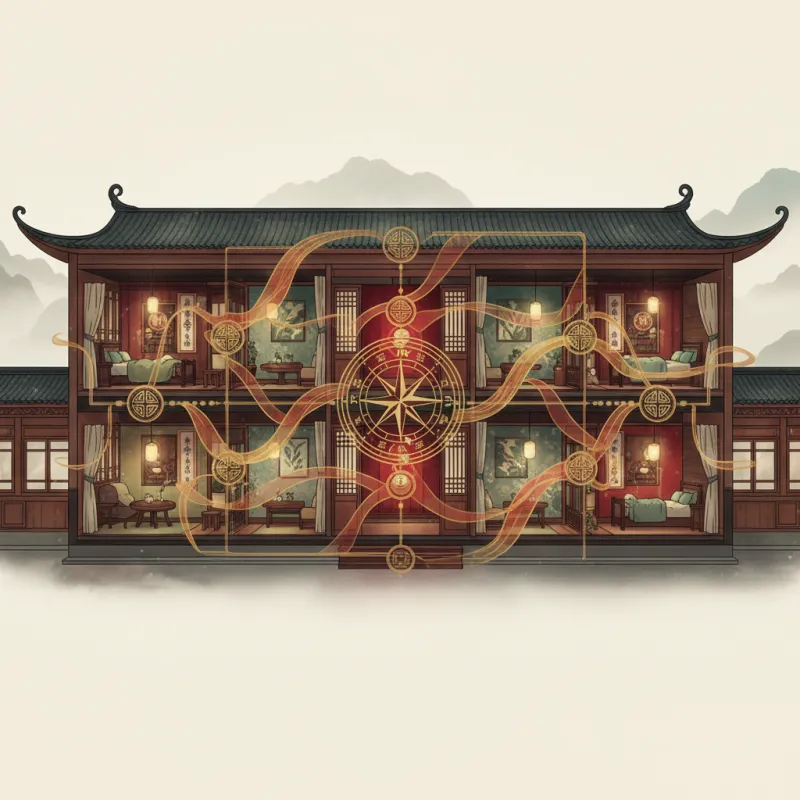
Your apartment's front door opens directly into your kitchen. Or worse — into a wall three feet away. Maybe you share a hallway with five other units, and your door is one of six identical panels painted the same institutional beige. The classical feng shui texts assume you control your entrance — a gate, a courtyard, a threshold you can design. But in apartment living, your "mouth of qi" (气口 qìkǒu) is often predetermined by a developer who never heard of the Yangzhai Sancai Tushuo (阳宅三才图说), the 1562 Ming dynasty manual that established residential feng shui principles.
This is the central challenge of apartment feng shui: you're working with constraints that would make a traditional practitioner wince. Yet millions of people in Hong Kong, Singapore, Tokyo, and New York have been adapting these principles to vertical living for decades. The solution isn't to abandon feng shui — it's to understand which principles are non-negotiable and which are flexible.
The Compression Effect: Why Small Spaces Amplify Everything
In a 2,500 square foot house, a cluttered corner represents maybe 2% of your total environment. In a 450 square foot studio, that same corner is 10% of your space. The math is simple, but the energetic implications are profound.
The Qing dynasty master Shen Shi (沈氏) wrote in the Shenshi Xuankong Xue (沈氏玄空学) that qi moves like water — it pools in open areas and stagnates in cluttered ones. In a small apartment, there's nowhere for stagnant qi to hide. It's right there, in your face, affecting your sleep, your mood, your ability to think clearly.
This compression effect means three things:
First, editing becomes essential. That decorative bowl you never use? In a house, it's neutral. In a studio, it's taking up precious surface area and collecting dust — literally creating sha qi (煞气 shàqì), or attacking energy. Every object needs to justify its presence through beauty, function, or emotional significance.
Second, maintenance matters more. A burnt-out lightbulb in a hallway is annoying in a house. In a one-bedroom apartment where that hallway connects your only two rooms, it's creating a daily passage through dim, depleted energy. The smaller your space, the faster small problems compound.
Third, multipurpose areas need energetic boundaries. When your bedroom is also your office is also your yoga studio, you need ways to signal different functions to your subconscious. This is where feng shui gets creative.
Entrance Solutions When You Can't Change the Door
You can't move your apartment door. You probably can't repaint the hallway outside it. But you can influence the transition from public corridor to private sanctuary.
The traditional solution is a screen or partition just inside the door — the yingbi (影壁), or spirit wall, that prevents qi from rushing straight through your space. In a small apartment, a full screen might block too much light or make the entrance feel cramped. Adapt it: a narrow console table, a tall plant, even a piece of art positioned to catch your eye as you enter. The goal is to slow the energy and create a psychological threshold.
If your door opens directly into your kitchen (a common apartment layout that classical texts warn against), you need a visual buffer. A curtain, a hanging plant, a decorative room divider — something that says "pause here" before you're confronted with your sink and stove. The principle from the Baxai Mingjing (八宅明镜) still applies: the entrance should offer a moment of transition, not immediate exposure to fire and water elements.
For doors that face a wall, use that wall strategically. A mirror expands the sense of space (though never directly opposite the door, which bounces qi back out). Art that depicts depth — a landscape, a pathway, an open vista — creates a psychological sense of possibility. You're correcting for the cramped reality with visual suggestion.
The Bed Placement Puzzle in Shared Spaces
In a studio apartment, your bed might be visible from the front door, positioned under a window, or sharing a wall with your neighbor's bathroom. None of these are ideal according to the Yangzhai Shishu (阳宅十书), the Song dynasty text that established the "command position" principle — bed positioned diagonally from the door, solid wall behind the headboard, clear view of the entrance.
But ideal isn't always possible. So you prioritize.
Non-negotiable: the headboard wall. Even if you can't achieve perfect command position, you need something solid behind your head while you sleep. In a studio, this might mean positioning your bed against the only solid wall available, even if it's not the "best" wall according to compass directions. A solid headboard helps, but the wall itself matters more. If you're stuck with a window behind your bed, get a substantial headboard and keep the window covered at night.
Flexible: the door view. If you can see the door from bed, excellent. If you can't, a strategically placed mirror can give you that visual connection without requiring you to rearrange your entire space. The principle is about feeling secure, not about rigid positioning.
Creative solution: the room divider. A bookshelf, a curtain track, a folding screen — anything that creates a visual separation between your sleeping area and the rest of your studio. This isn't just feng shui; it's basic psychology. Your brain needs to associate your bed with sleep, not with your laptop and your dirty dishes. The division doesn't need to be solid; it needs to be perceptible.
For those dealing with bedroom feng shui challenges, remember that in apartments, the quality of your sleep environment matters more than the quantity of space.
Vertical Thinking: Using Height When You Lack Square Footage
Classical feng shui focuses on horizontal space — the bagua (八卦 bāguà) map laid over a floor plan, the flow of qi through rooms. But apartments force you to think vertically. When you can't spread out, you build up.
High shelving draws the eye upward and makes ceilings feel higher. Tall plants (real ones — fake plants are dead energy, and in a small space, you feel it) create vertical green energy without consuming floor space. Hanging lights at different heights creates layers of illumination, which is more interesting to qi than a single overhead fixture.
The five elements (五行 wǔxíng) — wood, fire, earth, metal, water — can be represented vertically. A tall wooden bookshelf (wood element) with a small water fountain on top (water element) and metal bookends (metal element) creates a productive cycle in one vertical column. You're working with the same principles, just rotated 90 degrees.
Wall-mounted everything: desks, shelves, even planters. This keeps floor space open, which allows qi to circulate. The Qing dynasty master Jiang Dahong (蒋大鸿) emphasized that qi needs clear pathways. In a small apartment, those pathways are often just two feet wide. Keep them clear.
The Kitchen-Bathroom Dilemma
In many apartments, the kitchen and bathroom share a wall. Sometimes they're directly opposite each other. Classical feng shui considers this problematic — fire and water elements in conflict, plus the bathroom's downward-draining energy opposing the kitchen's nourishing function.
You can't move the plumbing. But you can manage the energetic relationship.
Keep bathroom doors closed. Always. This is the simplest intervention and the most effective. A closed door contains the bathroom's energy and prevents it from mixing with the rest of your space.
Use wood element as a mediator. Wood bridges water and fire in the productive cycle of elements. A wooden bath mat, wooden kitchen utensils displayed on the shared wall, even a wooden picture frame — these create energetic translation between the two spaces.
Maintain impeccable cleanliness. In a house, a slightly messy bathroom is contained. In an apartment where your bathroom is ten feet from your bed, that mess is in your energetic field constantly. The smaller your space, the higher your cleaning standards need to be.
For more on balancing elements in compact spaces, see our guide to five elements in modern homes.
Light, Air, and the Illusion of Space
The Zangshu (葬书), the 4th century text attributed to Guo Pu (郭璞), defines feng shui literally: wind and water. In an apartment, you're managing both with limited control over windows and ventilation.
Maximize natural light. Keep window treatments minimal during the day. Light is yang energy, and small spaces tend toward yin (dark, still, compressed). You need that yang infusion. If you have only one window, position your most-used areas near it. Let the light do the heavy lifting.
Create cross-ventilation when possible. Open windows on opposite sides of your apartment, even for ten minutes daily. Moving air is living qi. Stagnant air is stagnant energy. If you can't create cross-ventilation, use a fan to keep air circulating.
Layer your lighting. Overhead lights alone create flat, institutional energy. Add task lighting, accent lighting, even candlelight. Different light sources at different heights create depth and dimension — the illusion of more space, which becomes the reality of better energy flow.
Mirrors strategically placed. Not opposite the front door (bounces qi out), not opposite the bed (disturbs sleep), but positioned to reflect light and create visual expansion. A mirror reflecting a window doubles your natural light. A mirror reflecting a plant doubles your wood element. You're using reflection to multiply your limited resources.
The Clutter Equation: Less Space Means Less Tolerance
In the Lüshi Chunqiu (吕氏春秋), a text from 239 BCE, there's a passage about how a cluttered mind cannot perceive clearly. The same applies to cluttered space — and in an apartment, the threshold for "cluttered" is much lower than in a house.
The Western organizing expert Marie Kondo became famous for asking "does it spark joy?" — which is actually a feng shui principle. Objects that don't serve you energetically are draining you. In 400 square feet, you feel that drain acutely.
One in, one out. This is the apartment dweller's survival rule. Buy a new shirt, donate an old one. Bring home a new book, pass along one you've finished. Your space has a carrying capacity. Respect it.
Vertical storage, hidden storage. Under-bed boxes, over-door organizers, furniture with built-in storage. The goal is to keep surfaces clear. Clear surfaces allow qi to settle and circulate. Cluttered surfaces create visual noise that your nervous system processes as stress.
Seasonal rotation. You don't need your winter coat visible in July. Store off-season items, and rotate them. This keeps your active environment lean and relevant.
The apartment feng shui practitioner becomes a curator, not a collector. Every object is chosen, placed, and maintained with intention. This isn't deprivation — it's precision.
Making Peace with Imperfection
Here's what the classical texts won't tell you: perfect feng shui doesn't exist, and it especially doesn't exist in a rental apartment with a lease and a landlord.
Your door faces the "wrong" direction according to your kua number (卦数 guàshù). Your bathroom is in your wealth corner. Your bedroom shares a wall with the building's elevator shaft. These are real constraints, and some of them you simply cannot change.
The question isn't "how do I achieve perfect feng shui?" The question is "how do I optimize the space I have?"
This is where intention matters. The Daoist principle of wu wei (无为 wúwéi) — effortless action, working with what is rather than forcing what isn't — applies directly to apartment feng shui. You're not trying to make your studio apartment behave like a suburban house. You're trying to make your studio apartment the best version of itself.
Small adjustments compound. A plant here, a mirror there, a daily practice of opening windows and clearing surfaces. None of these are dramatic. Together, they shift the energy from cramped and stagnant to compact and intentional.
The apartment dwellers of Hong Kong have been proving this for generations. In some of the world's most expensive, most densely populated real estate, people create homes that feel spacious, peaceful, and energetically balanced — not despite their size, but through careful attention to the principles that matter most.
Your apartment isn't too small for feng shui. It's the perfect laboratory for learning which principles are essential and which are negotiable. In that constraint, there's unexpected freedom.
Related Reading
- Feng Shui for Your Home Entrance: First Impressions Matter
- Smart Home and Feng Shui: Can Technology and Tradition Coexist?
- Feng Shui Meets Minimalism: Where Ancient Wisdom and Modern Design Agree — Fengshui Perspective
- Feng Shui Meets Minimalism: Where Ancient Wisdom and Modern Design Agree
- Flying Stars Feng Shui: Time-Based Energy Analysis
- Chinese Palm Reading: What Your Hands Reveal
- Unlocking the Ancient Arts: Feng Shui, I Ching, and the Mysteries of Chinese Metaphysics
Explore Chinese Culture
- Explore Daoist philosophy and practice
- Explore traditional Chinese customs
- Explore ancient Chinese cosmology