Your apartment has seventeen throw pillows. You own three cheese graters. There are four half-empty bottles of the same shampoo under your bathroom sink. When did this happen? More importantly: why does walking into your own home feel like navigating an obstacle course instead of taking a deep breath?
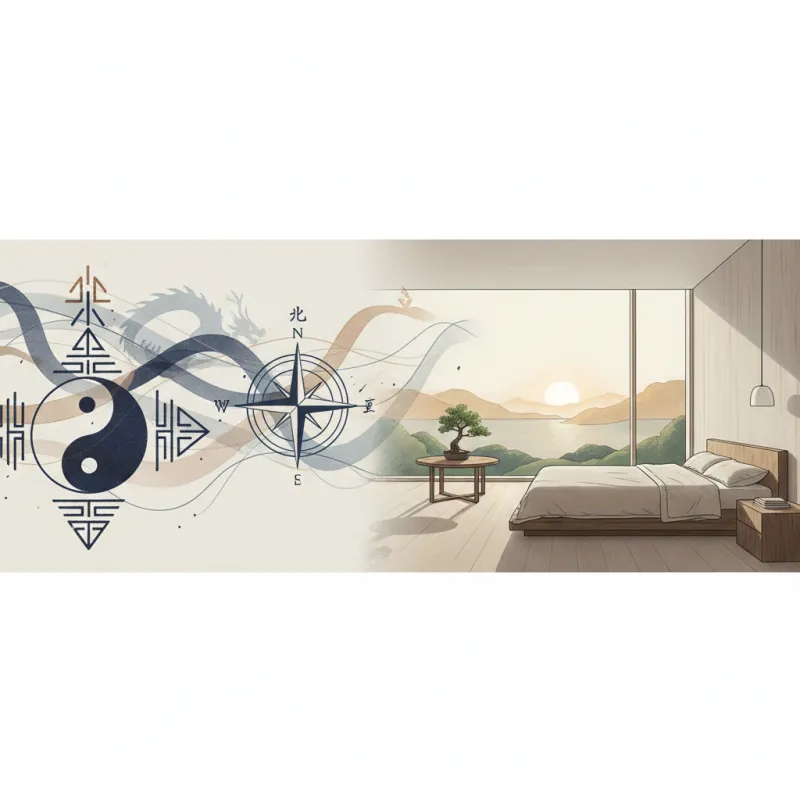
Here's what nobody tells you about minimalism and feng shui — they're not just compatible philosophies. They're the same philosophy wearing different clothes. One speaks the language of Scandinavian design blogs and capsule wardrobes. The other speaks the language of qi (氣, qì) and the five elements. But strip away the cultural packaging, and you'll find they're both saying the same thing: your environment shapes your life, and most of what you own is getting in the way.
The Clutter Paradox: Why More Stuff Means Less Energy
In feng shui theory, qi flows through your space like water through a stream. Smooth, unobstructed movement creates vitality. Blockages create stagnation, which manifests as everything from chronic fatigue to relationship problems to career plateaus. The classical feng shui text Yangzhai Sanyao (陽宅三要, Yángzhái Sānyào) from the Qing Dynasty identifies three critical factors for a harmonious home: the door, the bedroom, and the stove. Notice what's not on that list? Your collection of decorative objects.
Modern minimalism arrived at the same insight through a different route. The Bauhaus movement of 1920s Germany championed "form follows function" — the idea that objects should justify their existence through utility, not ornamentation. Japanese designer Kenya Hara later refined this into the concept of "emptiness" as a design element, arguing that negative space isn't absence but potential. An empty room isn't lacking furniture; it's full of possibility.
The overlap isn't coincidental. Both traditions recognize that physical clutter creates mental clutter. Neuroscience backs this up: a 2011 Princeton study found that visual clutter competes for your attention, reducing your ability to focus and increasing stress hormones. Your seventeen throw pillows aren't just blocking qi flow — they're literally exhausting your brain's processing capacity every time you walk into the room.
The One-In-One-Out Rule Meets the Bagua Map
Minimalists love rules. One in, one out. The 90/90 rule (if you haven't used it in 90 days and won't use it in the next 90, toss it). The capsule wardrobe. These aren't arbitrary restrictions — they're frameworks for decision-making in a culture that constantly pushes acquisition.
Feng shui offers a different framework: the bagua (八卦, bāguà), the eight-sided map that divides your space into life areas like wealth, relationships, and career. Each area corresponds to specific elements, colors, and energies. But here's what gets lost in translation: the bagua isn't a shopping list. It's not telling you to buy a fountain for your wealth corner or hang crystals in your relationship area. Traditional feng shui masters would look at your space and remove obstacles first, add enhancements second.
The Ming Dynasty feng shui master Jiang Pingjie wrote that the first principle of arranging a home is "kong" (空, kōng) — emptiness or spaciousness. Not as deprivation, but as the foundation for everything else. You can't assess the qi flow in a room that's packed with furniture. You can't determine the optimal placement for your bed when there are three other possible bed positions blocked by storage boxes and exercise equipment.
This is where minimalism and feng shui become practical allies. Use minimalist principles to clear the space. Use feng shui principles to arrange what remains. The minimalist asks: "Do I need this?" The feng shui practitioner asks: "Where should this go?" Answer the first question before tackling the second, and you'll save yourself from buying organizational systems for stuff you shouldn't keep in the first place.
Surfaces Tell Stories: What Your Coffee Table Says About Your Qi
Walk into any home and look at the horizontal surfaces. Kitchen counters. Coffee tables. Nightstands. Dressers. In most homes, these surfaces have disappeared under layers of accumulated objects — mail, keys, chargers, magazines, remote controls, half-empty water glasses, receipts, loose change, hair ties, pens that probably don't work.
Feng shui calls this "sha qi" (煞氣, shàqì) — attacking or negative energy. Not because the objects themselves are harmful, but because visual chaos creates energetic chaos. Your eye can't rest. Your mind can't settle. Every cluttered surface is a tiny decision you haven't made, a task you haven't completed, a thing you haven't put away. Multiply that by every surface in your home, and you're living in a constant state of low-grade stress.
The minimalist solution is ruthlessly simple: clear surfaces are the default state. Everything has a home. If it doesn't have a home, it doesn't belong in your home. This isn't about aesthetics (though clear surfaces do photograph well for Instagram). It's about reducing the cognitive load of existing in your own space.
But here's where feng shui adds nuance that minimalism sometimes misses. Not all surfaces should be completely empty. The entrance table (the first thing you see when you walk in) benefits from a single beautiful object — fresh flowers, a piece of art, a bowl for keys. This isn't clutter; it's intention. The difference? One carefully chosen object creates a focal point. Seventeen objects create visual noise.
The classical feng shui principle of "ming tang" (明堂, míng táng) — the bright hall or open space in front of important areas — applies here. Your front door needs clear space to gather qi. Your desk needs clear space to think. Your bed needs clear space to rest. These aren't arbitrary rules; they're observations about how humans actually function in physical space.
The Minimalist Bedroom Meets the Feng Shui Bedroom
Let's get specific. Your bedroom. In feng shui, the bedroom is one of the three critical areas (remember the Yangzhai Sanyao?). It's where you spend a third of your life, where you're most vulnerable, where you restore your energy. The feng shui rules for bedrooms are extensive: bed position relative to the door, no mirrors facing the bed, no electronics, no clutter under the bed, no work materials.
Minimalists have their own bedroom rules: no TV, no phone, no clutter, neutral colors, quality over quantity in bedding and furniture. The overlap is striking. Both traditions recognize that the bedroom should be a sanctuary, not a storage unit or home office or entertainment center.
Here's what this looks like in practice. The minimalist removes everything that doesn't serve sleep or intimacy. The feng shui practitioner positions what remains for optimal energy flow. The result? A room with a bed (positioned so you can see the door but aren't directly in line with it), two nightstands (symmetry supports relationship harmony), perhaps a dresser, maybe a chair. That's it. No treadmill. No desk. No pile of books you're "going to read." No storage boxes under the bed blocking qi flow.
The "no storage under the bed" rule trips people up. Where else are you supposed to put your winter clothes? The feng shui answer: somewhere else. The minimalist answer: do you really need that many winter clothes? The practical answer: if you must store things under the bed, use closed containers (not open boxes) and keep them organized. Chaos under the bed creates restless sleep, whether you believe in qi or not.
Color, Texture, and the Five Elements: Where Minimalism Gets Interesting
Minimalism has an aesthetic problem. In its most extreme form — all white walls, no decoration, no personal objects — it starts to feel sterile. Airbnb generic. Instagram-ready but not actually livable. This is where feng shui's five element theory (五行, wǔxíng) adds depth that minimalism sometimes lacks.
The five elements — wood, fire, earth, metal, water — aren't literal. They're categories of energy, each associated with colors, shapes, materials, and life areas. Wood (green, brown, vertical lines) represents growth and vitality. Fire (red, orange, triangular shapes) represents passion and transformation. Earth (yellow, beige, square shapes) represents stability and nourishment. Metal (white, gray, circular shapes) represents precision and clarity. Water (black, blue, flowing shapes) represents wisdom and flexibility.
A minimalist room might be perfectly uncluttered but energetically unbalanced — all metal (white walls, metal furniture, glass surfaces) with no wood or earth to soften it. The result feels cold, even if it's technically "clean." Feng shui suggests balance: if your room is predominantly metal, add wood through a plant or wooden furniture. If it's all earth tones, add metal through a mirror or metal frame.
This isn't about buying more stuff. It's about choosing the right stuff. One wooden bowl on a white shelf. A blue throw blanket on a beige sofa. A terracotta pot for your single plant. These aren't clutter; they're intentional choices that create energetic balance while maintaining visual simplicity.
The Japanese concept of "ma" (間, ma) — the space between things — captures this perfectly. It's not about emptiness for its own sake. It's about the relationship between objects, the breathing room that allows each element to be fully appreciated. A room with three carefully chosen objects has more presence than a room with thirty random objects, even if the thirty-object room is technically "decorated."
The Hardest Part: Letting Go of "Just in Case"
Here's where both minimalism and feng shui get real. The actual obstacle isn't understanding the principles. It's the emotional attachment to stuff. The "just in case" mentality. The "but it was expensive" rationalization. The "it was a gift" guilt. The "someday I'll" fantasy.
Feng shui addresses this through the concept of "old qi" (舊氣, jiùqì) — stagnant energy from objects you no longer use or love. That dress you haven't worn in five years? It's not waiting patiently in your closet. It's taking up physical space and energetic space, reminding you every time you see it that you're not the size you used to be or you don't go to those events anymore or you made a purchasing mistake. Every unused object is a tiny energy drain.
The minimalist approach is more direct: if you haven't used it in six months (or a year, depending on which minimalist you ask), you don't need it. But this misses the emotional complexity. Some things you don't use but genuinely love — the fancy china from your grandmother, the guitar you played in college, the hiking boots from that memorable trip. Feng shui makes room for these objects, but with a caveat: they must be honored, not hidden. Display the china or donate it. Hang the guitar on the wall or sell it. Put the boots where you can see them or let them go.
The key insight both traditions share: keeping things "just in case" is a scarcity mindset. It assumes you won't be able to get what you need when you need it. It assumes the future is threatening rather than abundant. This isn't about reckless disposal — keep the fire extinguisher and the first aid kit. But the three cheese graters? The seventeen throw pillows? The exercise bike you haven't touched in two years? Those aren't security. They're obstacles disguised as preparation.
Living With Less, Living With More
The goal isn't deprivation. It's not about living in an empty white box with one chair and a sleeping mat. Both minimalism and feng shui, properly understood, are about creating space for what matters. The minimalist creates space by removing what doesn't serve. The feng shui practitioner creates space by arranging what remains to support energy flow. Together, they create homes that are both beautiful and functional, both simple and alive.
Start small. Clear one surface completely. Not "organize" it — clear it. See how it feels to walk past that surface for a week. Notice whether you miss anything that was there. Then move to the next surface. Apply the same principle to closets, drawers, storage areas. Remove first, organize second, enhance third.
Use feng shui principles to guide what stays and where it goes. Your home entrance should be clear and welcoming. Your bedroom should support rest. Your workspace should support focus. Each area has a function; let that function determine what belongs there.
The result won't look like a magazine spread or a feng shui textbook. It'll look like your life, but with the volume turned down. Less visual noise. Less decision fatigue. Less guilt about unused objects. More space to breathe. More energy for what actually matters. More room for qi to flow, whether you call it that or just call it feeling better in your own home.
Marie Kondo asks if it sparks joy. A feng shui master asks if it supports qi flow. But maybe the better question is simpler: does this object earn its place in your life? If the answer is no, you already know what to do.
Related Reading
- Feng Shui Meets Minimalism: Where Ancient Wisdom and Modern Design Agree — Fengshui Perspective
- Smart Home and Feng Shui: Can Technology and Tradition Coexist?
- Feng Shui for Apartments: Making Small Spaces Work
- Burial Feng Shui Explained: Ancestral Graves and Family Fortune
- Compass School Feng Shui: When Direction Becomes Destiny
- Kitchen Feng Shui: Cooking Up Prosperity
Explore Chinese Culture
- Explore Daoist philosophy and practice
- Explore traditional Chinese customs
- Explore ancient Chinese cosmology