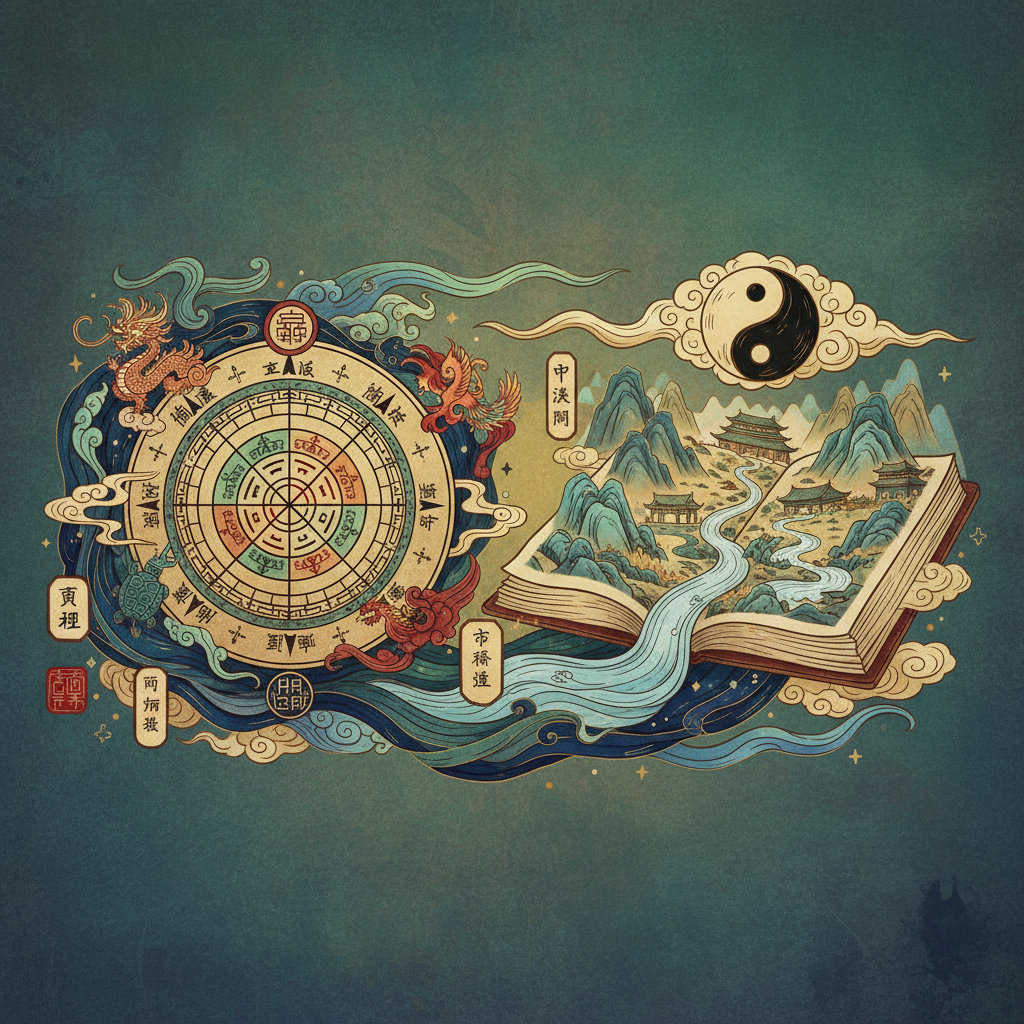
Understanding Feng Shui: An Ancient Art of Placement
Feng Shui, a harmonious practice deeply rooted in Chinese culture, focuses on the arrangement of space and its energy, or "qi." Its origins date back over 3,000 years to the time of the Shang Dynasty, where initial practices revolved around geomancy—interpreting the landscape's energy. The term "Feng Shui" itself translates to "wind" (feng) and "water" (shui), elements that symbolize the flow of qi and the nurturing forces of nature.
In its essence, Feng Shui promotes balance and harmony within a space, influencing not just physical environments but also emotional and spiritual well-being. Practitioners believe that achieving a balanced flow of energy can lead to prosperity, health, and happiness. It has evolved into a sophisticated system that includes various methodologies, from simple home adjustments to advanced metaphysical analysis.
The I Ching: A Cornerstone of Chinese Divination
The I Ching, or Book of Changes, is one of the oldest classics in Chinese literature and philosophy, dating back to the Western Zhou period (1046–771 BC). This ancient text serves as a divinatory tool and a philosophical guide, guiding individuals through life's uncertainties by providing insight into prevailing energies and their transformations.
The I Ching operates on the principle of change, represented through hexagrams comprised of six lines, which are either broken or unbroken. When consulted, these hexagrams symbolize different aspects of human experience and challenge, forming a framework for understanding personal and societal dynamics. The I Ching embodies Confucian and Daoist philosophies, emphasizing harmony with the cosmos and self-awareness.
The Interconnection of Feng Shui and the I Ching
Feng Shui and the I Ching are entwined through their foundational belief in the power of qi and the dynamics of change. In Feng Shui, the I Ching is employed to interpret environmental energies, allowing practitioners to make more informed decisions about spatial arrangements. Each Feng Shui area correlates with specific hexagrams from the I Ching, enabling a layered understanding of personal and environmental dynamics.
For instance, the Bagua map, used in Feng Shui to delineate different life aspects, is directly mapped to the I Ching’s hexagrams, facilitating a deeper insight into how spatial energy influences emotions, health, and relationships. This synergy between the two practices enhances the compass with which one navigates not just physical spaces, but the personal journey of life.
Cultural Significance: Feng Shui and I Ching in Contemporary Society
In recent years, the concepts of Feng Shui and the I Ching have permeated Western culture, often adapted into various lifestyle practices such as interior design and personal development. Many now seek Feng Shui consultants for guidance in arranging their homes or workplaces to foster a sense of well-being and abundance. The I Ching, on the other hand, provides a form of intuitive decision-making that has appealed to those looking for spiritual direction or insight.
Educational institutions have also begun incorporating these ancient practices into courses that explore Chinese philosophy and its relevance in contemporary contexts. The wisdom of the I Ching encourages individuals to reflect on their choices and actions, promoting a culture of mindfulness and intention in an increasingly chaotic world.
The Role of Geomancy and Divination in Chinese Metaphysics
Geomancy, or "divinatory geomancy," holds a crucial role in both Feng Shui and the I Ching, connecting human existence to the natural world through the interpretation of earth’s energy patterns. This practice emphasizes the belief that significant insights about the past, present, and future can be gleaned from the land, guiding practitioners in decision-making and forecasting.
Divination methods, like those found in the I Ching, serve as an interconnected system of wisdom. These practices urge individuals to consult the changes around them—not just physical alterations, but shifts in personal and cultural landscapes. By aligning oneself with these patterns, practitioners claim to navigate life’s complexities with ease.
Conclusion: Embracing the Wisdom of Feng Shui and the I Ching
Feng Shui and the I Ching represent much more than mere cultural artifacts; they are living philosophies poised to enrich our understanding of life's interconnectivity. By learning to harness the energies of our environments and understanding the patterns of change, we can achieve a more harmonious existence, both individually and collectively. Embrace these ancient traditions, and you might find that the path to balance and abundance is clearer than ever.